



There’s a fairy tale about living up in the moon palace, where you are no one. You live through other people’s light. This is my step down
On the Way Down From the Moon Palace is the debut solo album by Lisa Germano, self-released in 1991 on her own Major Bill Records label. Recorded mostly at September Recording in Indianapolis, Indiana, with Germano performing the majority of the instrumentation herself, it announced an artist whose sensibility—intimate, melancholic, and stubbornly genre-resistant—would prove foundational to everything that followed. The album moves fluidly between country-tinged folk-pop, Celtic-inflected fiddle instrumentals, Dylanesque blues, and hushed, meditative pieces that seem to exist in a world entirely their own. Though overlooked at the time of its initial release, Moon Palace caught the attention of Capitol Records, setting in motion the sequence of events that would bring Germano to a wider audience.
Background
By 1991, Lisa Germano had been touring as John Mellencamp’s violinist for several years, a role that brought visibility but defined her publicly in ways that had nothing to do with her own creative voice. Germano had always been writing her own music, and being on the road made that writing more necessary. The songs on Moon Palace took shape as a form of private reckoning, a way of processing the loneliness and dislocation of life as a session and touring musician.
Mellencamp, to his credit, encouraged her to take the work further. His support helped push Germano toward actually releasing the album rather than keeping the songs to herself. She self-financed the project and established Major Bill Records to put it out—a label name that acknowledged both what the record cost her and her own dry, self-deprecating humor. In the album’s credits, she lists herself not by name alone, but as “The Emotional Wench Lisa Germano,” a gesture that’s part joke, part manifesto.
In a January 1992 Spin feature, Germano was profiled as Mellencamp’s violin player who had made her own album on the side. The article, headlined “Lisa in the Sky with Violins” (Marc Allan, Spin, Vol. 7, No. 10, January 1992), helped put the record on the radar of industry figures who might otherwise have missed it entirely. Capitol Records came calling, and the signing that would produce Happiness (Capitol Version) in 1993 followed in short order.
Germano has been candid in interviews about what Moon Palace is and isn’t. She’s described it as something closer to a set of demos or sketches, a largely acoustic collection made to satisfy her own creative needs rather than to launch a career. That modesty is understandable but somewhat undersells it. The record contains writing of genuine force and invention, and its rough-edged self-sufficiency is inseparable from its character.
Themes
Moon Palace is a record about endurance—specifically, the kind of endurance required to keep one’s footing in circumstances that push hard against it. Taken as a whole, the album documents the emotional life of someone navigating bad relationships, the peculiar isolation of the road, threats both ambient and explicit, and the question of how to remain intact in the face of all of it.
The title track, an instrumental, sets the tone immediately: the moon palace of the album’s epigraph is a place of anonymity and borrowed light, a retreat from the world rather than a home in it. Coming down from that place is the work the album then undertakes across its thirteen tracks. Several songs address love gone badly wrong—”Hangin’ With a Deadman” (co-written with Greg Edward) and “Cry Baby” take up relationships that have turned hollow or corrosive, while “Bye Bye Little Doggie,” with its contrast of acoustic gentleness against menacing mandolin and violin, finds a harder, more resigned tone. “Dig My Own Grave,” a Dylanesque electric blues, turns the self-deprecation almost comic before letting it land with full weight.
“Riding My Bike” occupies a different register entirely. Brief and disquieting, it chronicles an encounter with danger from the perspective of a child or a narrator rendered childlike by vulnerability—a foretaste of the way Germano would treat gendered threat on later albums like Geek the Girl. The song’s mandolin-and-drums arrangement keeps it nursery-rhyme simple against deeply unsettling subject matter.
A number of the album’s tracks are instrumental—Calling…,” “Screaming Angels Dancing in Your Garden,” “Simply Tony,” “The Other One,” “Dark Irie”—and they are not mere interludes. They carry as much emotional weight as the songs with words. “The Other One,” with its floating, nearly Enya-esque violin, points toward the more atmospheric direction Germano would explore on subsequent records. The instrumentals allow the album to breathe and shift register in ways that straight song-cycle structures rarely permit.
“Guessing Game (or The Music Business)” names the record industry directly, suggesting that even at this early stage Germano was under no illusions about the machinery she was adjacent to. The dry parenthetical registers as knowing and slightly weary—a working musician’s joke, but one with a point.
Released: 1991
Label: Major Bill Records
Catalog No: MB0191
Formats: CD, Cassette
Country: US
Availability: Moderate
| No. | Title | Length |
|---|---|---|
| 1 | On the Way Down From the Moon Palace | 4:00 |
| 2 | Guessing Game (or The Music Business) | 3:04 |
| 3 | Blue Monday | 3:30 |
| 4 | Calling | 1:02 |
| 5 | Hangin’ With a Deadman | 3:49 |
| 6 | Screaming Angels Dancing in Your Garden | 2:55 |
| 7 | Riding My Bike | 1:58 |
| 8 | Simply Tony | 2:04 |
| 9 | Dig My Own Grave | 3:18 |
| 10 | Cry Baby | 3:27 |
| 11 | Bye Bye Little Doggie | 4:27 |
| 12 | The Other One | 3:44 |
| 13 | Dark Irie | 2:50 |
Moon Palace was recorded and mixed at September Recording in Indianapolis, Indiana, engineered and mixed by Mark Hood and Paul Mahern. The recording is lo-fi in character but not in affect—it has a purposeful, handmade quality that suits the intimacy of the material without sounding accidental or underfinished.
Most of the instrumentation was performed by Germano herself, including violin, fiddle, piano, mandolin, accordion, and other instruments. The album’s primary rhythm section was a drum machine, used throughout with care rather than as a default convenience. Germano brought in drummer Kenny Aronoff, her Mellencamp bandmate, on “Guessing Game (or The Music Business),” “Blue Monday,” and “Hangin’ With a Deadman”—whose fuller sound gives those particular songs added momentum. Jeff Hedback played bass on “Guessing Game (or The Music Business).”
Germano served as her own producer throughout, mixing most of the album alongside Hood and Mahern, though she took sole mixing credit on certain tracks.
The album’s production makes full use of Germano’s violin as both a lead melodic instrument and a textural one—an approach that would become a consistent feature of her catalog. On Moon Palace, the violin functions sometimes as a string voice, sometimes as fiddle, and sometimes as an ambient presence sitting just at the edge of the song rather than leading it.
Packaging & Design
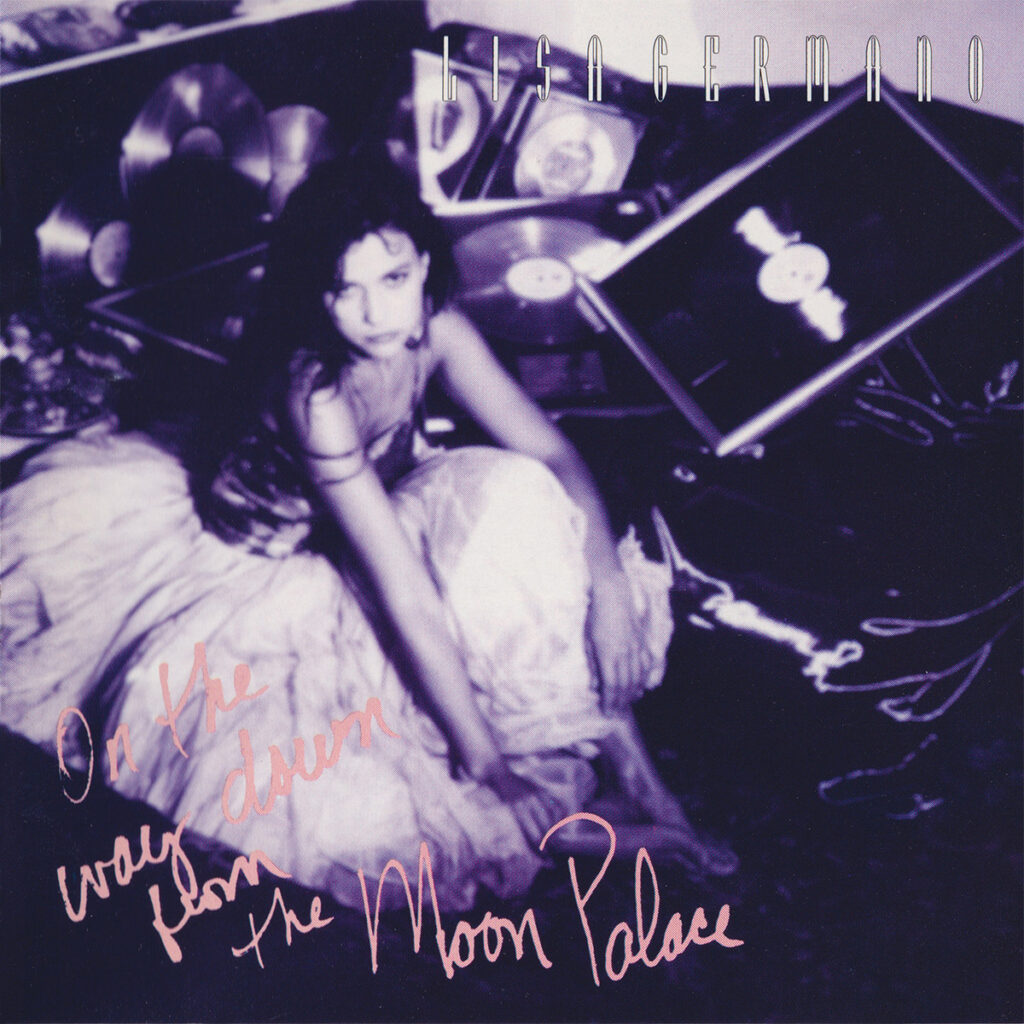
The original 1991 Major Bill Records release features a close-up cover photograph of Lisa by Andrew Scalini, rendered against a softly lit background. The album title appears in a flowing pink script, with Germano’s name set in a contrasting font below. Inside photography was handled by David Engelking. Art direction was by P.J. Yinger. The aesthetic is intimate and handmade, consistent with the album’s independent, self-directed spirit.
In the liner notes, Germano credits herself as “The Emotional Wench Lisa Germano—a small act of self-definition that doubles as a kind of preemptive description of the emotional territory the record covers.
The 1993 Egg Records reissue (catalog number EG02CD) reproduced the original artwork and tracklist without changes, adding only a label logo mark within the liner notes.

The 1999 Koch Records reissue (KOC-CD-7999) made more visible alterations. The cover photograph is scaled down and placed within a substantial decorative frame, changing the overall visual register of the artwork considerably. The pink script title is replaced with a font matching the styling used for Germano’s name, though in titlecase. The result is a more formal and less personal presentation, somewhat at odds with the character of the album itself.
Additional Versions
| Label | Format | Catalog No. | Country | Year | |
|---|---|---|---|---|---|
 | Major Bill | CD | MB0191 | US | 1991 |
| Major Bill | Cassette | MB0191 | US | 1991 | |
| Egg Records | CD | EG02CD | US | 1993 |
 | Koch Records | CD | KOC-CD-7999 | US | 1999 |
Personnel
Kenny Aronoff: Drums on “Guessing Game (or The Music Business),” “Blue Monday,” and “Hangin’ With a Deadman”
Jeff Hedback: Bass on “Guessing Game (or The Music Business)”
Lisa Germano: All other instruments (violin, fiddle, piano, mandolin, accordion, guitar, drum machine, vocals)
All songs written by Lisa Germano, except “Hangin’ With a Deadman,” co-written with Greg Edward
Produced by Lisa Germano Engineered and mixed by Mark Hood and Paul Mahern
Additional mixing on select tracks by Lisa Germano
Recorded and mixed at September Recording, Indianapolis, IN
Art direction by P.J. Yinger
Cover photography by Andrew Scalini
Interior photography by David Engelking
Critical Reception
On the Way Down From the Moon Palace attracted limited coverage at the time of its initial 1991 release, as was typical for a self-financed independent album from an artist then best known as a touring sideperson. The successive reissues by Egg Records in 1993 and Koch Records in 1999 each brought fresh attention, and it is largely through those reissues that the album found its critical record.
“Germano’s papery, intimate vocals and expressive violin hooks suffuse the music with a melancholy that would only increase on her next two albums.”
Michael Azerrad / Brad Reno
Trouser Press
“Germano’s papery, intimate vocals and expressive violin hooks suffuse the music with a melancholy that would only increase on her next two albums.”
Annie Holub
Arizona Daily Wildcat
“Lisa Germano’s debut album On the Way Down From the Moon Palace is considerably rootsier and poppier than her later efforts, but the album showcases her skills as an arranger and her wonderfully expressive, versatile violin playing, particularly on the title track, “Dark Irie,” and “Screaming Angels Dancing in Your Garden.”
Heather Phares
AllMusic
Related Press

Mellencamp Violinist Says She’s Got Best of Two Career Worlds
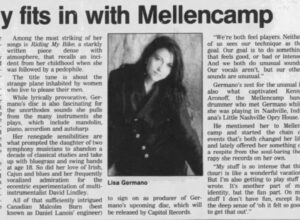
‘Feel’ Fiddler Finally Fits in With Mellencamp
Record Deal, ‘Grace’ Songs Keep Germano in Limelight
Related Releases