



Are you up or down? Waves of information make you realize you can go to ANOTHER PLANET of waves that suit you… but only you can let go of the familiar.
In 1998, Slide became Germano’s fourth and final album on 4AD. She had been consistently busy throughout the decade, releasing new music almost every year while regularly touring. When she wasn’t on tour, she was writing new songs at home in Bloomington, Indiana.
To prepare for the release of Slide, 4AD encouraged her to meet with new producers and musicians and work with them out in Los Angeles. Open to trying something new, Germano ended up finding an apartment and got to work.
“When you’re so used to feeling dead all the time, it takes a while to get used to feeling alive. That’s kinda why it’s called Slide, because you’re wanting to be in an upper place but you keep falling back down because that’s what you’re used to. It’s really just been within the last few months that I really feel super-uplifted. When I was making the record, I was going down and up a lot.”
— Lisa Germano, Magnet Magazine (August 1998)
Slide brought a fuller, band-oriented sound to her introspective songwriting. Produced and mixed by Tchad Blake—a trusted friend and collaborator—and featuring an ensemble of accomplished session musicians, the album is widely regarded as one of the most accessible of Germano’s catalog, and the most polished record she would ever make.
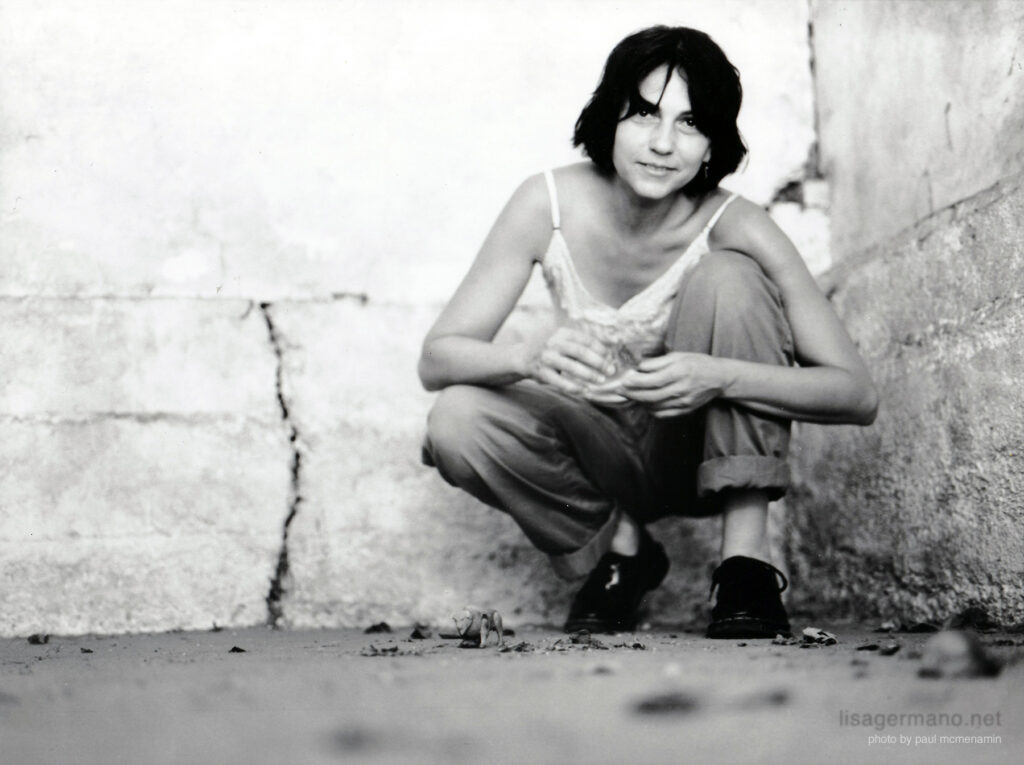
Slide was recorded primarily at the Sound Factory (also known as Sunset Sound Factory) in Hollywood, California, with additional home recordings by Germano herself. The sessions were produced and mixed by Tchad Blake, whose distinctive approach to sound—drawing on analog outboard gear, binaural microphone techniques, and an ear for textural psychedelia—gave the album its rich, enveloping quality. Blake and Germano had worked together previously, and she later described him as someone who understood intuitively that every song needed its own mood and world.
Blake at the time was closely associated with producer Mitchell Froom, with whom he had formed one of the most fruitful creative partnerships in 1990s alternative music. Between 1992 and the early 2000s, the two collaborated on acclaimed records by Crowded House, Suzanne Vega, Elvis Costello, Richard Thompson, and Los Lobos, and together formed the experimental Latin Playboys alongside Los Lobos members David Hidalgo and Louie Pérez. The musicians assembled for Slide were largely drawn from this same circle. Froom himself plays on the record, as do drummer Jerry Marotta (a veteran of Peter Gabriel’s band and sessions with Paul McCartney and Carly Simon), bassist Jerry Scheff (longtime Elvis Presley collaborator), guitarist Joe Gore (Tom Waits, PJ Harvey), guitarist Craig Ross (Lenny Kravitz), and drummer Pete Thomas (Elvis Costello’s Attractions).
Slide saw release in the fall of 1998 and received warm praise from critics. CMJ New Music Monthly called the album Germano’s best to date, writing that she was “becoming more melodically grounded,” but sales were reportedly scant, somewhere in the range of 6,000 copies. 4AD, unable to justify continued investment, dropped her from their roster. Germano later reflected on the decision without bitterness: “They’re still my friends, but I understood. They’ve got to pay the bills.”
The Smashing Pumpkins episode that preceded the album’s release had already shaken her confidence. After weeks of rehearsals in Chicago and London in preparation for the Adore tour, she received a call from Billy Corgan’s camp the night before the first show that she was no longer needed—with no explanation given. A confused and discouraged Germano made her way back to Indiana to retrieve her cats before eventually returning to Los Angeles.
Despite the setback of losing her label, Germano promoted Slide through a small run of shows and continued to offer musical support to other artists’ projects. She worked part-time at Book Soup, a West Hollywood bookstore, and during this period seriously considered walking away from music altogether. Her future as a recording artist remained genuinely uncertain until she met producer Tony Berg, a customer at the bookstore familiar with her work, who encouraged her to return to the studio. That encouragement would eventually lead to Lullaby for Liquid Pig in 2003.
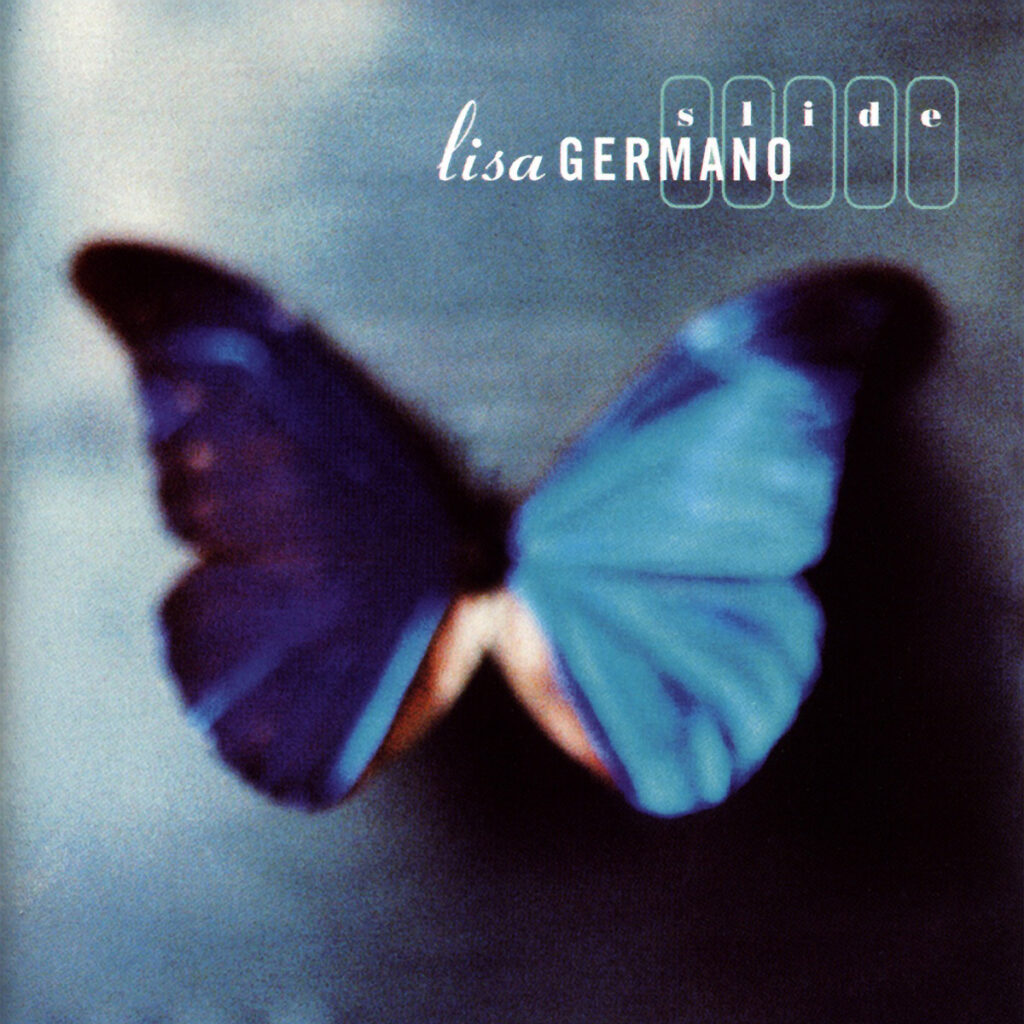
Released: October 14, 1998
Label: 4AD
Catalog No: CAD 78014 CD
Format: CD
Country: US
Availability: Moderate
| No. | Title | Length |
|---|---|---|
| 1 | Way Below the Radio | 4:15 |
| 2 | No Color Here | 4:29 |
| 3 | Tomorrowing | 3:59 |
| 4 | Electrified | 4:46 |
| 5 | Slide | 2:22 |
| 6 | If I Think of Love | 3:03 |
| 7 | Crash | 4:23 |
| 8 | Wood Floors | 4:03 |
| 9 | Turning Into Betty | 4:22 |
| 10 | Guillotine | 3:52 |
| 11 | Reptile | 3:35 |
Slide balances Germano’s established intimacy with a more structured and expansive sound. “Way Below the Radio,” the album’s opener and its only official single, is a thumping, hypnotic number that builds to a hazy, anthemic chorus—and, in characteristic Germano fashion, a quietly self-deprecating one. Its lyrics (she sings, almost affectionately, about having fun “way below the radio”) read as a gentle acknowledgment of her own unmarketability, and set the tone for an album that is simultaneously her most commercial and most resigned about what that means. Other songs like “Tomorrowing” and “Crash” bristle with energy, while the title track and the unsettling “Guillotine” offer meditative stillness. “Wood Floors,” a piano-led ballad about learning to be alone with oneself, is among the finest things Germano has ever recorded; it was later covered by Norwegian vocalist William Hut on his solo debut Road Star Doolittle.
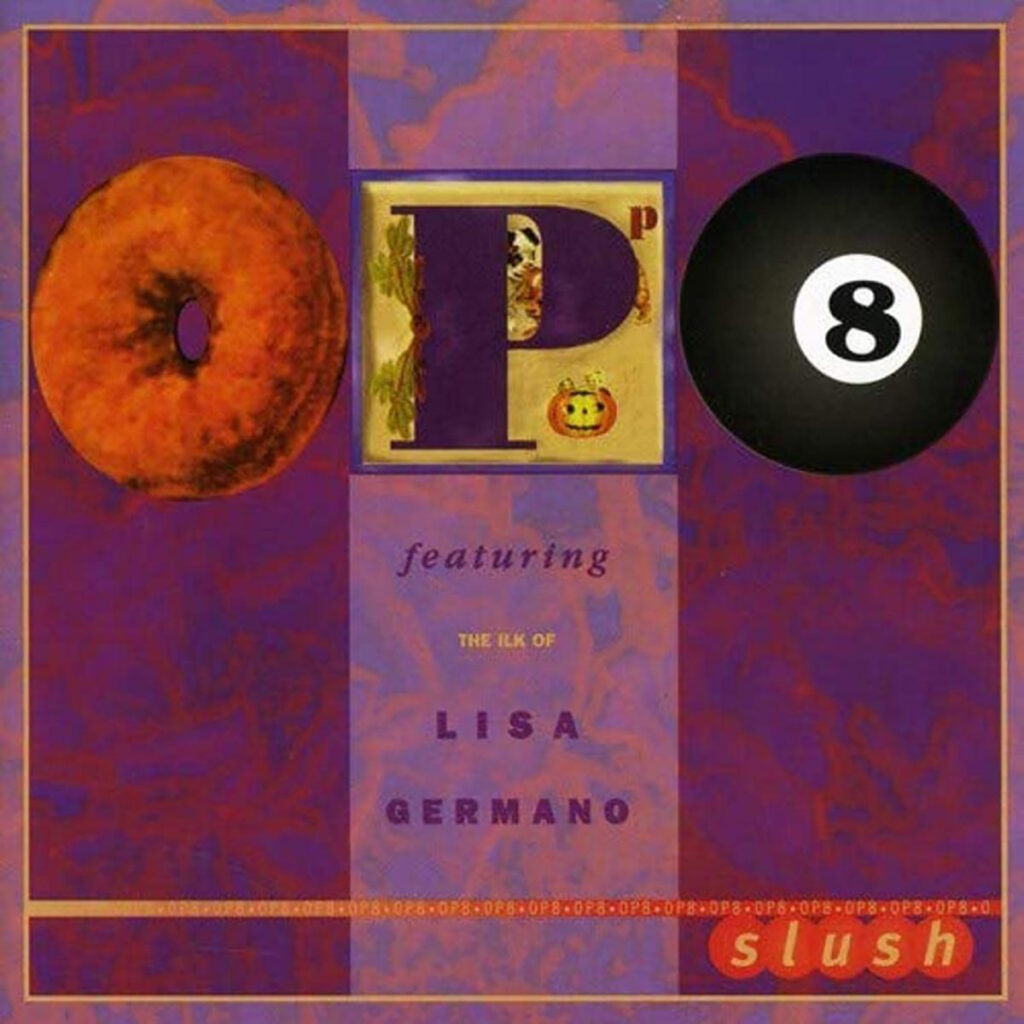
“If I Think of Love” had surfaced earlier: Germano first recorded the song for Slush, the 1997 OP8 album she made with members of Giant Sand and Calexico. The version on Slide strips away the ramshackle desert-rock production in favor of Blake’s cleaner, more romantic arrangement, and the song gained a wider audience in this form—it has since been covered by multiple artists, including New York electropop project Burnside Project and LD Beghtol, a collaborator of The Magnetic Fields. Closing track “Reptile” would later find an unexpected second life when it was featured in Jonathan Caouette’s 2003 documentary Tarnation, one of the few instances of a Germano song finding its way into a major film release.
Packaging & Design
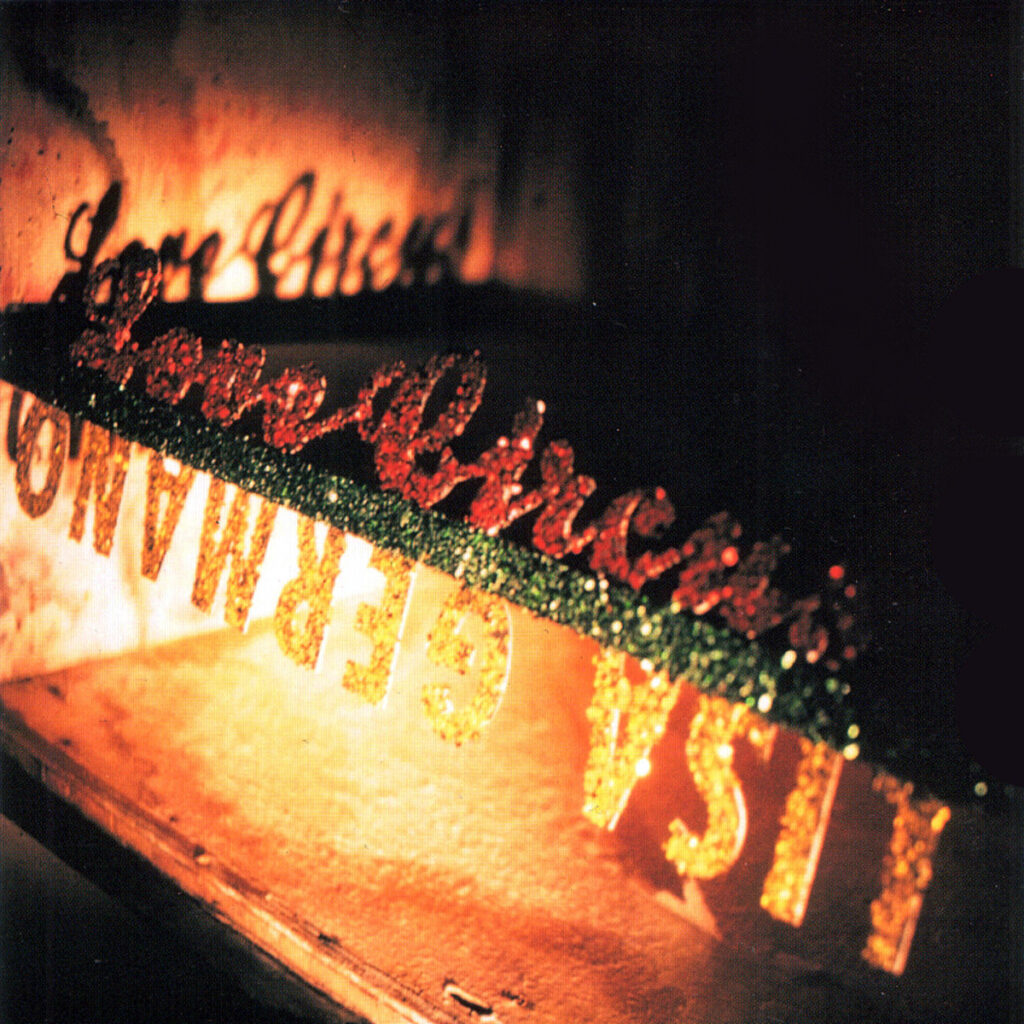
Like many 4AD releases of the era, Slide featured careful and evocative packaging. Released in a standard jewel case, the album’s art direction and design were handled by Paul McMenamin of V23, the influential design collective that served as 4AD’s visual identity arm throughout the 1980s and 1990s. Photography was by Matthew Welch, with illustration by Paige Imatani.


Additional Versions
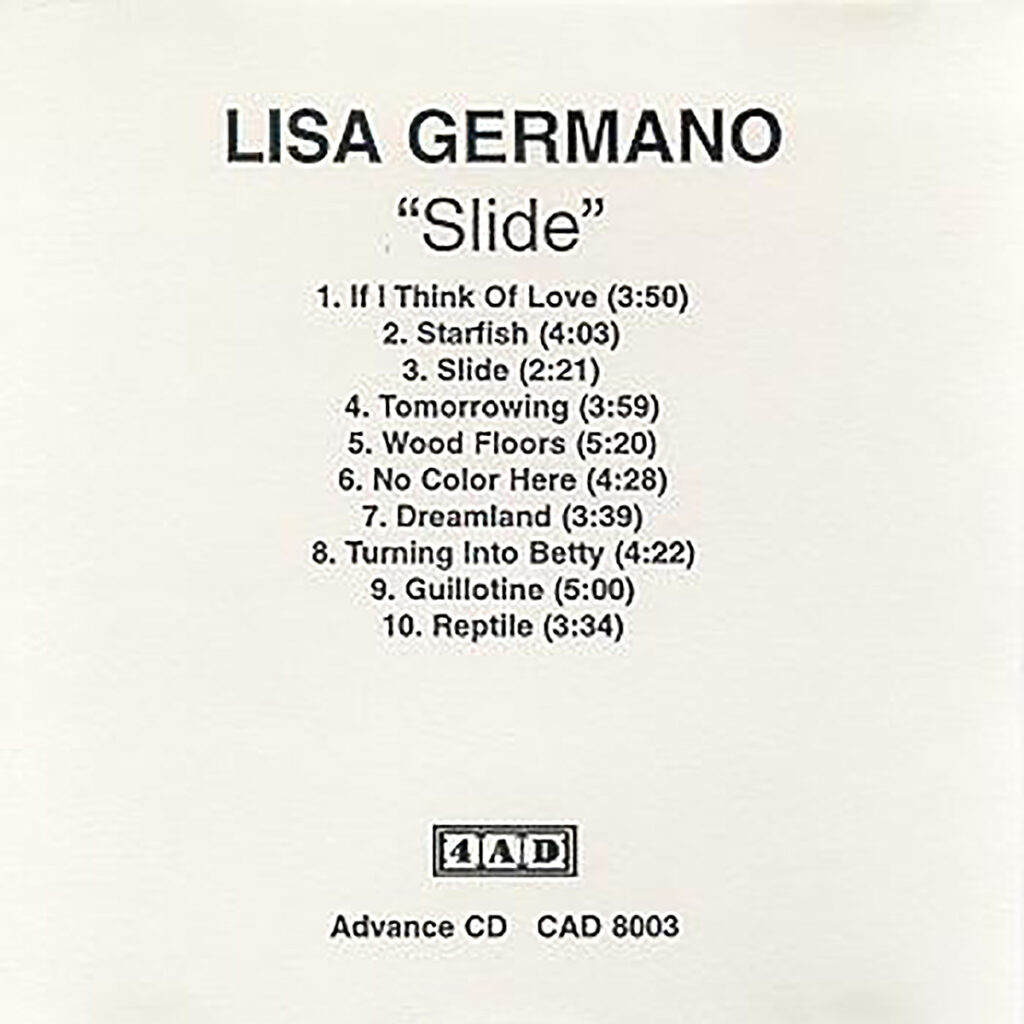
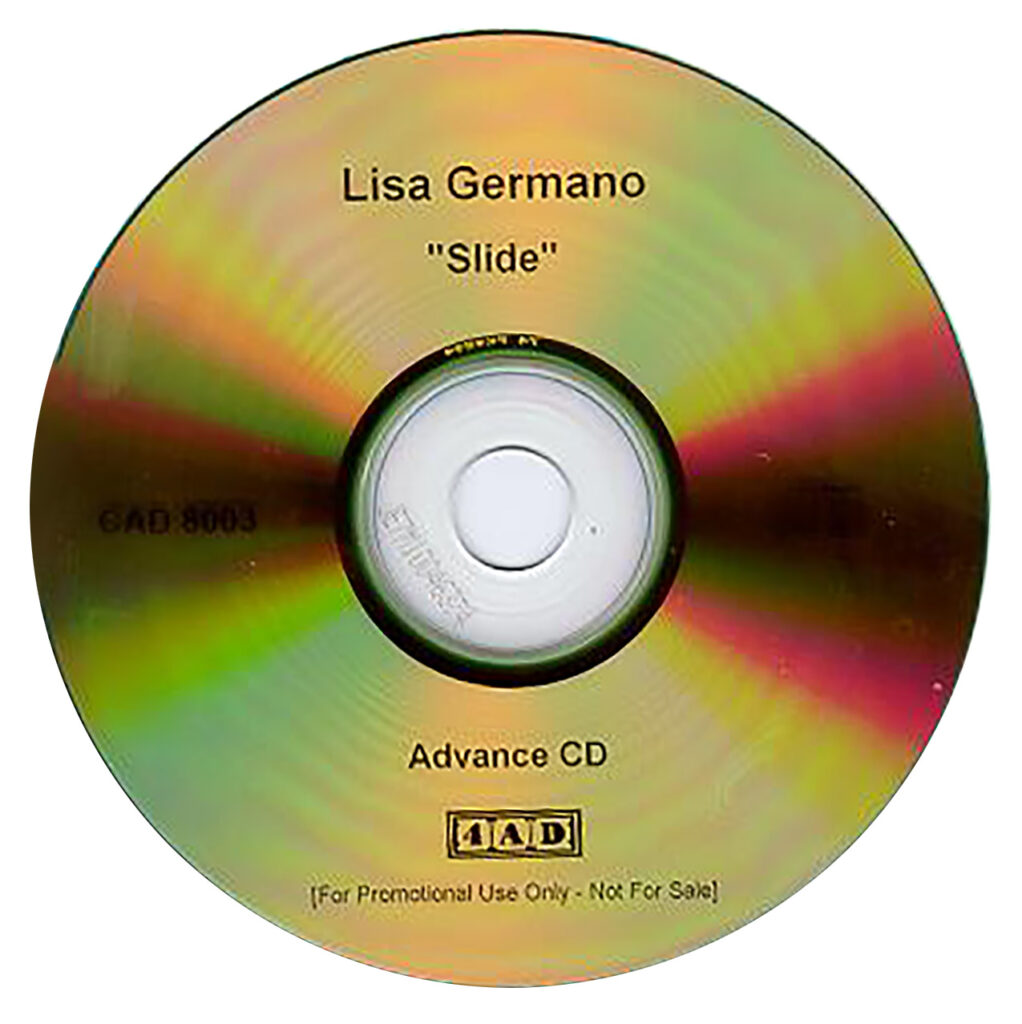
A reported early advance version of Slide featured a completely different track list than what was ultimately released.
This 10-track version had “If I Think of Love” kicking off the album with “Way Below the Radio,” “Electrified,” and “Crash” missing. Run times of familiar songs are also different indicating some alternative versions were previously considered. Most notably is that songs “Starfish” and “Dreamland” were initially part of earlier sequencing.
“Starfish” would later be included on the Pet Sounds compilation and later on Rare, Unusual or Just Bad Songs.
“Dreamland” remains an unofficial release, appearing only on Rare, Unusual or Just Bad Songs.
Although “Starfish” and “Dreamland” were indeed originally considered as part of the album initially, this particular advance CD isn’t listed on Discogs. It also features a catalog number of CAD 8003 which was eventually issued to former label-mate’s Kristin Hersh’s 1998 album, Strange Angels.
| Label | Format | Catalog No. | Country | Year | |
|---|---|---|---|---|---|
 | 4AD | CD | CAD 78014 CD | US / UK | 1998 |
| 4AD Labels | CD | 724384672720 | France | 1998 |
| PIAS Benelux 4AD | CD | 170.8014.20 CAD 78014 CD | Belgium | 1998 |
| 4AD Shock | CD | CAD 8014 CD | Australia | 1998 |
| Rough Trade 4AD | CD | RTD 120.2167.2 | Germany | 1998 |
| 4AD MNW ILR | CD | CAD 78014 CD | Sweden | 1998 |
| Everlasting | CD | EVERCD068 | Spain | 1998 |
| 4AD | CD Advance Promo | CAD 8014 A | US | 1998 | |
| 4AD | CD | CAD 8014 CD | Canada | 1998 |
| 4AD Rock Records | CD | RCCY-1028 | Japan | 1998 |
| Rock Records | Cassette Promo | None | Japan | 1998 | |
| 4AD | CD | 8 46727 2 | Italy | 1998 |
| 4AD | CD Reissue | CAD 78014 CD | UK | 1998 |
Personnel
Musicians:
Craig Ross, Jerry Marotta, Jerry Scheff, Joe Gore, Lisa Germano, Mitchell Froom, Peter Thomas, and Tchad Blake
Produced and mixed by Tchad Blake
Mastered by Bob Ludwig at Gateway Mastering
Recorded by Lisa Germano, S. Huskey Hoskulds, and Tchad Blake at the Sound Factory in Los Angeles, CA
Art Direction & Design by Paul McMenamin
Photography by Matthew Welch
Illustration by Paige Imatani
Management: Tommy Manzi
Published by Emotional Wench/Polygram Songs BMI
Critical Reception
Name almost any under-recognized artist and someone will say that if he or she were only marketed correctly or heard by the right people, a star would be born. It’s hard to imagine anyone making that claim about the under-recognized Lisa Germano, whose songs are so personal, ambiguous, and unsettling that even sympathetic listeners can find it hard to gain entry.
Still, Slide is one of the more accessible albums in Germano’s catalog, lacking both the harrowing sexual dramas of Geek the Girl and the overt self-loathing of Happiness. The songs here feature Germano’s trademark carnival-music textures, but are both subtler and prettier than usual, which sometimes makes them even more disturbing: “No Color Here” and “Crash,” both about depression, are so tender and closely observed they’re nearly fetishistic.
Elsewhere, Germano lets some air into her universe: the lilting “Electrified” remembers a time when “playing was everything,” “Wood Floors” is a beautiful piano ballad, and “Turning Into Betty” is a darkly humorous song about the fear of turning into one’s mother. Even Germano’s lighter moments are disorienting, though; when she sings “I’m giving in to beauty,” it sounds less like an epiphany than a potentially fatal error.
Kristi Coulter
AllMusic
Related Press
Lisa Germano’s Better Place

Happy to be centre stage, at long last

Lisa Germano: Geek Love
Related Releases