



Released in 1994 as a US-only promotional CD, Stars was the first single 4AD issued in advance of Geek the Girl. It is the most minimal release in Germano’s singles discography: a single track, no original artwork, no b-sides, no remixes—just the album version of the closing track circulated to radio programmers and press contacts ahead of the album’s release. No commercial version was ever made available.
The choice of “Stars” as the lead promotional vehicle was a pragmatic one. Of the twelve tracks on Geek the Girl, it was the most sonically approachable—brief, melodically direct, and driven by a jangly guitar figure rather than the home-recorded intimacy and dissonance that characterized much of the album. Its surface brightness made it a credible submission to college and alternative radio in 1994. What it concealed, heard outside the album’s context, was exactly what made it matter inside it.
Background
Geek the Girl arrived in October 1994 as Germano’s first album of entirely new material for 4AD, just six months after the label reissued her second album, Happiness. As Germano later recounted in Martin Aston’s book Facing the Other Way, the album was not conceived as a calculated artistic statement—it emerged from a period of writing without expectation of an audience. “When you don’t think anyone will hear your stuff,” she said, “you really get down to some deeper stuff.” The result was a record 4AD itself reportedly found denser and more difficult than hoped. As Germano told Rolling Stone: “It definitely wasn’t the ‘pop’ record 4AD was looking for.”
“Stars” was the exception, the song most plausibly aligned with what alternative radio might have absorbed in late 1994. Spin eventually ranked the title track 91st on its list of the 100 best alternative rock songs of the 1990s, and the album 84th among the decade’s best. Germano’s music was reaching the right ears, even if slowly. The Stars promo was part of the label’s effort to give it a foothold at radio before the full album’s weight arrived to complicate that task.
Themes
“Stars” is the epilogue to Geek the Girl‘s narrative. The Paste Magazine retrospective (A/V Club, January 2026) described it with precision: the song “arrives and immediately tells on itself.” What sounds like relief—a lighter tempo, a more open sound, lyrics oriented toward escape and fantasy—is, on examination, something more complicated. The lyrics don’t resolve the album’s traumas; they describe learning to live alongside them. “Great excuses make it easier to forget that awful feeling” is not a triumphant line. It’s a survival tactic articulated with perfect clarity by someone who has learned to use it.
The song’s central image—stars as objects of longing precisely because they are unreachable, safe to look at precisely because they can never be touched—carries the album’s whole argument in miniature. The character hasn’t healed. She’s found a way to keep going. The A/V Club piece put it well: “Far away from here” repeats until it sounds less like a destination than an incantation, something you say so your body doesn’t fold into itself.
The PopMatters retrospective called it a “balm, a hardly won resolution,” while noting that deprived of its album context it risks sounding like a rather unremarkable indie-pop song. That’s true, and it’s also the point. The song’s emotional force is inseparable from the eleven tracks that precede it. The Frascilita folk tune—the Sicilian interlude Germano uses three times on the album for what she described as “comic relief”—plays immediately before “Stars” on the original pressing, a brief, strange hinge between the album’s last reflective moment and its coda. Rate Your Music described “Stars” as “the epilogue,” while one reviewer called it “sarcastic and cynical but also romantic—a kind of hellish power pop” that “proved some kind of reverence” at the album’s close.
Spectrum Culture framed the song’s function most cleanly: “Geek has lived through a traumatic sexual awakening yet is still dreaming of finding a better man and fantasising about escape. She’s left at a crossroads and the listener can decide for themselves where her life heads in the future: broken by her experiences or taking control of her narrative.” The album doesn’t answer the question. It ends.
The A/V Club piece offered the most concise summary of what the single-track promo was packaging and sending to radio: “Geek the Girl doesn’t end on a cure. It ends on the only thing that feels honest after undergoing the ultimate violation: a compromise with being alive.”
Released: 1994
Label: 4AD
Catalog No: PRO-CD-7184
Format: CD
Country: US
Availability: Rare
| No. | Title | Length |
|---|---|---|
| 1 | Stars (Album Version) | 2:34 |
“Stars” is one of four tracks on Geek the Girl that received additional production from Malcolm Burn and session drums from Kenny Aronoff, recorded and mixed at Echo Park Studio in Bloomington, Indiana. The album’s liner notes identify “Stars” specifically as one of the Aronoff/Burn-assisted tracks (listed as track 12 on the album). The remaining eight tracks were home-recorded by Germano alone, primarily on a four-track, with Germano performing all instruments herself.
The song’s production is relatively open and bright compared to the rest of the record; Aronoff’s kit gives it a physical pulse that most of the album deliberately avoids, and the guitar work has a jangly, forward quality that Spectrum Culture’s retrospective accurately described as “more upbeat and indie-pop than the previous eleven songs.” This was not accidental. The track’s sonic difference from its surroundings is structural—part of what makes it function as a closing movement rather than another verse in the album’s ongoing interior monologue.
Packaging & Design
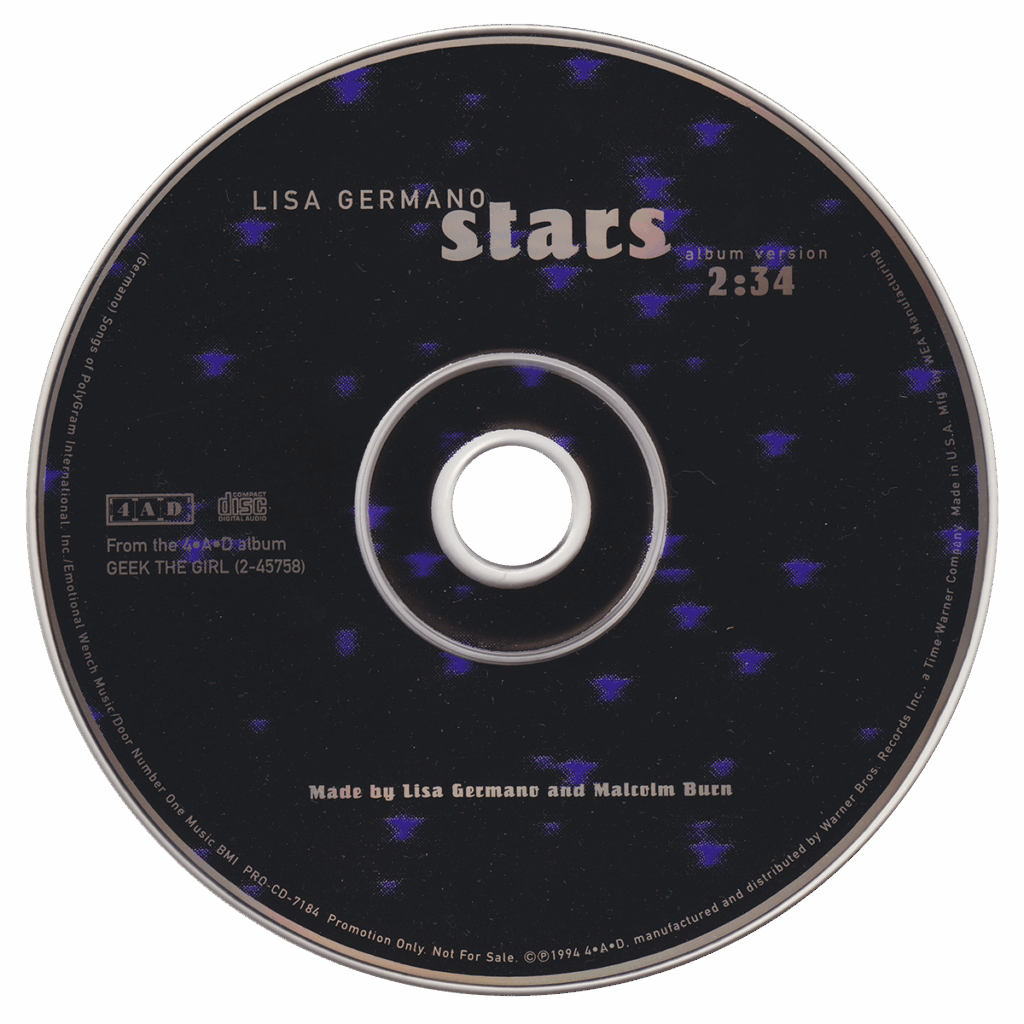
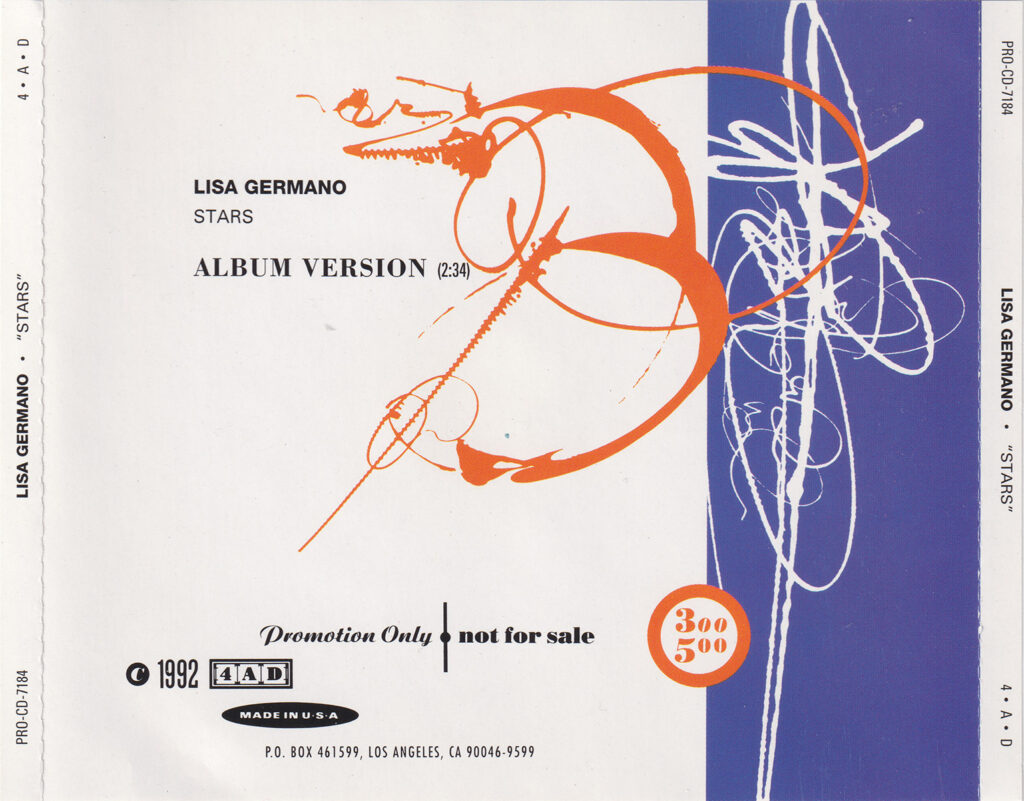
The Stars promo is notable for its complete absence of original artwork. Issued in a standard jewel case, the disc itself carries the only visual design—black printing with purple stars, Germano’s name, the track title, duration, and standard label copy. The back cover is 4AD’s generic promotional template.
This was not unusual for advance radio singles. The purpose of a track-only radio promo was functional circulation rather than presentation, and many labels reserved custom artwork for commercial releases. What gives the Stars promo its archival character is partly this plainness: it is a purely functional object, sent ahead of the album to introduce programmers to the song most likely to translate to their audiences.
No commercial single was ever released.
Lyrics
Why do people like stars?
They’re so far away
They’re always there
And safe to look at
Wish upon one
I could’ve been you
In that fantasy
Far away from here
I love my man
Could it be he takes me there?
All those stars lighten up my head
Here it comes again
That uneasy feeling
I could’ve been you in that fantasy
So smile so real big
And wish upon one
Let it take you far away from here
Far away from here
Far away from here
Far away from here
I could do about anything
Great excuses make it easier
To forget that awful feeling
So smile real big
A precious moment
In this vague world full of fantasies
LIke my man
Could it be he takes me there?
Anywhere
Far away from here
Far away from here
Far away from here
Far away from here
I could do about anything
Personnel
Written by Lisa Germano
Published by Songs of Polygram International / Door Number One Music / Emotional Wench Music BMI
Produced by Malcolm Burn
Drums: Kenny Aronoff
Mixed and recorded at Echo Park Studio, Bloomington, Indiana
Mastered by Greg Calbi at Masterdisk
℗ 1994 4AD
Related Releases